
The greatest form of power may not be the ability to control people through force, money or authority. It may be the ability to influence what they believe, how they perceive reality and, ultimately, how they behave.
There is a fascinating conversation in the globally popular television series Game of Thrones that carries a much deeper philosophical message than many viewers may have realized.
It happens between Varys and Tyrion Lannister.
Varys presents Tyrion with a riddle involving three powerful men: a king, a priest and a wealthy man.
Each of them wants the other two dead. Standing between them is an ordinary soldier, holding a sword.
The king commands him to kill the other two.
The priest makes the same demand.
The wealthy man also offers him a reason to obey.
But the soldier has only one sword.
Who does he obey?
Who really has the power?
Is it the king, because he commands the army?
Is it the priest, because he represents religious authority?
Is it the wealthy man, because he controls financial resources?
Or is it the soldier, because he is the one holding the weapon?
The question appears simple, but Varys introduces a much deeper possibility: perhaps power belongs to the person who can convince others that they have power.
This is a profound observation about human psychology, society and the nature of influence.
And it connects directly to something we explore extensively at WitsValley: the relationship between information, perception, subconscious programming and human behaviour.
Because the same principle that influences how people obey authority can also influence how they understand the world, how they see themselves and what they believe is possible in their lives.
Let’s explore.
1. The Greatest Battlefield Is the Human Mind

For centuries, powerful nations expanded their influence through military conquest, territorial occupation and economic domination.
Those instruments of power still exist today.
However, another battlefield has become increasingly important: the human mind.
Think about it.
Before someone supports a war, opposes a government, accepts a particular economic system or develops an opinion about another country, they must first form an understanding of what is happening.
Where does that understanding come from?
Information.
But information does not simply arrive in its purest form.
It is selected, organised, interpreted, packaged and distributed.
The same event can be presented in completely different ways depending on who tells the story, which facts are emphasised, which voices are given attention and which perspectives are excluded.
One country may describe a military intervention as protecting democracy. Another may describe the same intervention as interference in its sovereignty.
One movement may be presented as a liberation struggle, while another source may describe it as an insurgency.
The language changes the interpretation.
And the interpretation influences how people feel about what they are seeing.
This is the power of narrative.
The person who influences the narrative can influence the perception. And perception is the key in influencing decisions.
You do not always have to tell people what to do when you can influence how they understand the world in which they make their decisions.
This is why the human mind has become one of the most important areas of influence in modern civilisation.
2. How Powerful Nations Influence What the World Believes
Western countries, particularly the United States and major European powers, have developed considerable international influence through political, economic, cultural and technological institutions.
Their influence extends beyond military strength.
Let’s examine some of the mechanisms through which this happens.
Global Media: The Power of Framing
International media organisations influence which events receive attention and how those events are presented.
But reporting an event and framing an event are not necessarily the same thing.
Framing involves deciding which aspects of a story receive emphasis, which historical background is included, whose voices are considered authoritative and which details receive less attention.
Imagine two countries experiencing similar political unrest.
If one is consistently described as fighting for freedom while another is described as threatening stability, audiences may develop very different impressions before examining the circumstances themselves.
This does not mean every media organisation operates according to one political agenda.
It means that whoever has significant influence over information distribution can also influence public interpretation.
What receives attention matters.
What gets omitted matters.
And the language used to describe events matters.
Technology Platforms: Who Controls What We See?
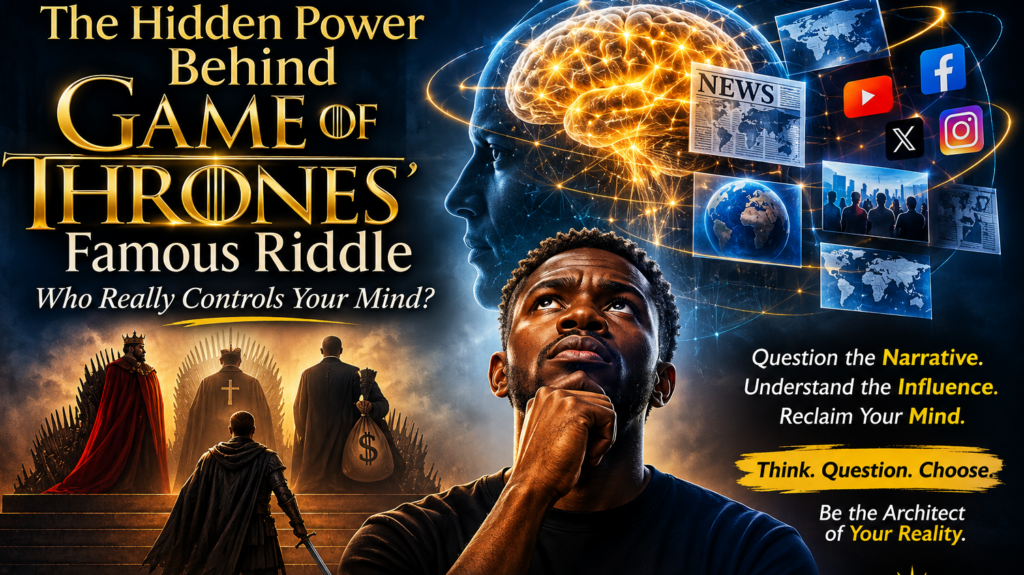
Consider the digital environment.
Millions of people across Africa and the rest of the world depend on platforms such as Google, YouTube, Facebook, Instagram and other digital services for information.
These platforms do more than simply connect people.
Their algorithms influence what appears in our feeds, which content receives visibility and what we are repeatedly exposed to.
Their policies influence what is restricted, labelled or removed.
Their recommendation systems influence what we discover and what remains outside our attention.
This creates an important question:
Who determines what information becomes visible to billions of people?
And whose interests, values and priorities influence those decisions?
The objective is not to reject technology or assume that every platform has a hidden political agenda.
It is to understand that information infrastructure is also a form of influence.
Cultural Influence: Programming What Success Looks Like
There is another dimension that is even more subtle.
Movies, music, fashion, entertainment and advertising influence how people imagine success, beauty, wealth, relationships and social status.
For decades, American and European cultural products have travelled across the world, influencing how people dress, communicate, consume and sometimes measure their own worth.
Cultural exchange is valuable. We can learn from different societies.
However, problems emerge when people begin assuming that one culture’s standards represent the universal definition of success.
A young African may grow up consuming thousands of hours of entertainment that presents Western lifestyles as the ultimate expression of achievement, while rarely encountering equally visible representations of African innovation, intellectual achievement and possibilities.
Over time, these repeated images can influence aspirations and expectations.
The most effective cultural influence does not always feel like influence.
Sometimes, it simply feels like normal life.
3. Your Subconscious Mind Is Also Being Programmed
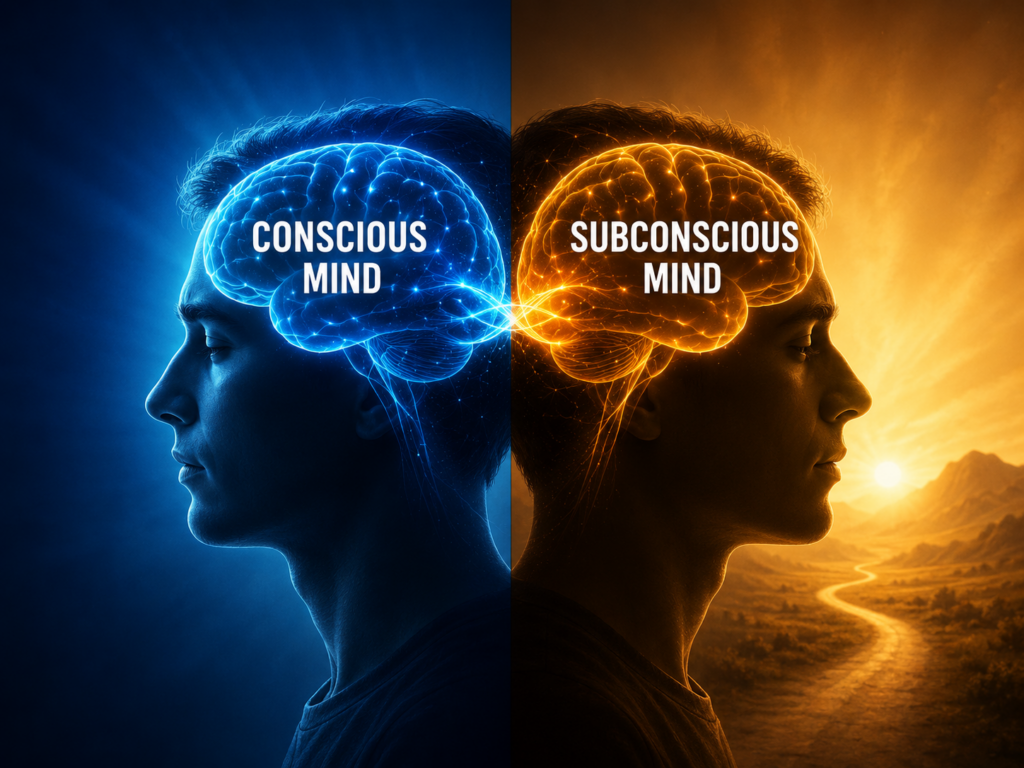
Now let’s bring this discussion closer to home.
At WitsValley, one of the fundamental principles we teach is that the mind is constantly receiving information and forming associations.
Your experiences, conversations, education, entertainment, environment and repeated thoughts contribute to the mental patterns through which you interpret life.
Consider a child who grows up repeatedly hearing:
“We are poor.”
“People like us never become successful.”
“Money is difficult to find.”
“Success is only for people with connections.”
These statements may initially appear to be ordinary conversations.
But repeated exposure can gradually influence how that child understands money, opportunity, identity and personal potential.
The child may grow into an adult who automatically associates wealth with difficulty, success with privilege and opportunity with something available only to other people.
Nobody needs to give that adult a direct instruction to avoid success.
The underlying assumptions may already influence their decisions.
This is one of the reasons subconscious programming matters.
The information you repeatedly expose yourself to can become part of the mental framework through which you interpret your reality.
The same principle applies to positive programming.
When you consistently expose yourself to empowering ideas, constructive information, positive imagery and new possibilities, you give your mind different patterns to work with.
Instead of repeatedly reinforcing helplessness, you can begin reinforcing personal responsibility.
Instead of constantly rehearsing limitation, you can begin developing a mindset of creativity, opportunity and resourcefulness.
This is not simply about thinking positively.
It is about becoming conscious of the mental instructions you repeatedly give yourself.
4. The Most Dangerous Programming Is the Programming You Do Not Recognise
Return to the riddle.
The king, priest and wealthy man each represent different sources of authority.
But what if the soldier’s understanding of these men has already been shaped by years of information?
What if he has been taught that the king is untouchable?
What if he has been conditioned to believe that questioning the priest is forbidden?
What if he has grown up believing that wealthy people are naturally more important than everyone else?
His decision may appear to be his own.
But how much of that decision is influenced by ideas he never consciously examined?
This is where the riddle becomes a lesson in awareness.
Human beings do not always respond to the world exactly as it is.
We respond to the world as we interpret it.
And our interpretations are influenced by our previous experiences, assumptions, memories and mental conditioning.
Two people can encounter the same opportunity and see completely different possibilities.
One sees a chance to build something.
The other sees a reason why it cannot work.
The opportunity is the same.
The interpretation is different.
This is why awareness is so important.
Before accepting an idea as truth, learn to examine it.
Before adopting someone else’s definition of success, question it.
Before concluding that something is impossible, investigate the assumptions behind that conclusion.
You may discover that some of the limitations you experience are not necessarily limitations imposed by reality, but conclusions reinforced by the way you have learned to interpret reality.
5. Africa and the Importance of Intellectual Independence
This conversation is particularly important for Africa.
For generations, African societies have encountered narratives about development, poverty, education, governance and economic progress that have often been shaped by external perspectives.
Some contain valuable lessons.
Others deserve serious examination.
The problem begins when receiving information becomes the same as accepting it.
A country can achieve political independence while remaining heavily dependent on external sources of knowledge, technology, information and intellectual validation.
It can have its own government, flag and constitution while much of its understanding of the world continues to be shaped by narratives originating elsewhere.
True independence requires more than political sovereignty.
It also requires intellectual independence.
Africa needs strong research institutions, credible journalism, technological capacity, universities, local knowledge systems and the ability to produce and distribute its own information.
But intellectual independence does not mean rejecting everything Western.
It means developing the capacity to examine ideas from every direction without automatically accepting the authority of their source.
We should be able to learn from America, Europe, China, India and every other part of the world without surrendering our ability to think independently.
The objective is not to replace one form of intellectual dependence with another.
It is to develop independent minds capable of examining evidence, recognising opportunities and creating new possibilities.
6. Reclaiming Your Mind: Becoming the Architect of Your Own Reality
Now we arrive at the most important lesson.
The riddle is not only about kings, priests, wealthy men, soldiers or political authority.
It is also about you.
Who has the greatest influence over the thoughts you repeatedly entertain?
Who determines the ideas you accept about money, relationships, success, health and your future?
Who decides what you consider possible?
Are you consciously choosing the information that shapes your thinking, or are you allowing your environment to make those decisions for you?
At WitsValley, we teach that personal transformation begins with awareness.
You cannot consciously redesign your life while remaining completely unaware of the mental patterns influencing your decisions.
Think of your subconscious mind as a garden.
Every day, you are planting something through the information you consume, the thoughts you repeat, the images you entertain and the emotions you repeatedly experience.
If you constantly plant seeds of fear, inferiority, resentment and limitation, you reinforce mental patterns associated with those experiences.
If you deliberately cultivate thoughts of confidence, creativity, abundance, discipline and possibility, you begin developing a different mental environment.
But planting the seeds is only the beginning.
You must also nurture them through repetition, emotional engagement, deliberate action and consistent practice.
This is why we encourage practices such as:
- Affirmations: Repeating empowering statements that reinforce the identity you want to develop.
- Visualisation: Creating clear mental pictures of the person you are becoming and the future you intend to build.
- Meditation: Developing awareness of your thoughts and learning not to react automatically to every mental impression.
- Conscious information consumption: Becoming intentional about the ideas, stories and environments you repeatedly expose yourself to.
- Daily action: Translating your inner vision into practical decisions, habits and behaviours.
You are not simply a passive recipient of information.
You can become an active participant in shaping your mental environment.
And when you change the patterns guiding your decisions, you begin changing the direction of your life.
7. The Final Question: Who Is Writing the Story You Believe?
Let’s return to Varys and Tyrion.
The king has political authority.
The priest has religious authority.
The wealthy man has financial resources.
The soldier has the sword.
But there is another possibility.
What if the greatest influence belongs to the person who has shaped the soldier’s understanding of all four?
That is the deeper significance of the riddle.
Power does not operate only through what people possess.
It also operates through what people believe, what they accept and what they consider possible.
This principle applies to governments, institutions, cultures, organisations and individual human beings.
And it brings us to one of the most important teachings of self-mastery:
Do not surrender the responsibility of thinking for yourself.
Question the information you receive.
Examine the assumptions you carry.
Be conscious of the stories you repeatedly tell yourself.
Do not allow the opinions of others to become the permanent boundaries of your imagination.
Learn from the world, but remain the architect of your own mind.
Because the same mind that can be influenced by external narratives can also be trained to examine them, challenge them and consciously choose a different direction.
The ultimate question is not simply who controls the weapons, the money or the institutions.
It is who influences the ideas through which people understand reality.
And on a personal level, perhaps the most important question is:
Are you consciously designing the reality you want to experience, or are you unconsciously living inside a mental programme that someone or something else helped create?
The first step towards freedom is awareness.
The next is taking responsibility for what you allow to shape your mind.
And the journey is learning to become the architect of your own life.
WitsValley — Rewire Your Mind. Redesign Your Life.
Your mind is the foundation. Your awareness is the awakening. Your daily choices are the building blocks of your future.
If you find this article thought-provoking, don’t keep it to yourself. Share it with your friends, family and loved ones. Someone you care about may need to see the world from a different perspective.
Sometimes, one powerful idea can change the way a person thinks forever.
Let’s spread awareness, encourage independent thinking and inspire more people to question, learn and grow.